Thursday, April 11, 2013

Big-seller Honda Accord just gets better


Mark Glover's AutoGlo car reviews also can be seen on the Business page of The Sacramento Bee's website – via the "GALLERY: Reviews of new cars" link at www.sacbee.com/business

This review originally appeared in the March 2013 edition of the Northern & Central California Cruisin’ News published out of Folsom, California – mg

Sacramento, California – Just based on sales history alone, you kind of figure that the Honda Accord doesn’t need much help.  It sells like crazy, right?

But Honda’s engineers are rarely content to just sit back and relax.  For this ninth-generation Accord, they’ve raised the ante.  While the latest Accord does not scream sporty or sexy, it is a car to be desired.  Oh, let me count the ways.

My tester was the 2013 Accord EX sedan with a continuously variable transmission, starting at $25,405.  Like previous Accords, you know that it will run pretty much forever, trouble-free.  And the gas mileage numbers on the 2.4-liter, four-cylinder engine are pretty nice at 27 miles per gallon in the city and 36 mpg on the highway.

Fit and finish on this midsize model are, as usual, spot-on.

Five minutes into my test drive, I’m overwhelmed by totally unanticipated surprises.  Good ones.

For starters, the Accord was more than peppy.  It was downright robust, the 185-horsepower engine delivering seat-of-the-pants performance way beyond what the numbers would indicate.  I was ripping the tester around like a weekend racer teen in his first NASCAR ride.  Feels good?  Yeah, it does.

Based on my experience with the four-banger, I can only guess that the optional 3.5-liter V-6 must feel like a perpetual trip to Rip City.

Even so, the tester was thinking green.  When I was coasting with my foot off the gas or braking, green semicircles lit up around the speedometer to let me know I was driving in “eco” mode.  Yeah, that felt pretty good too.

So, I got the scare of my life the first time I flipped on the right-turn signal, and an exterior image of everything from my right-front passenger door on back to eternity flashed onto the video screen mounted center dash.

Might have helped if I’d read the owner’s manual first, but I later learned that this was Honda’s “LaneWatch Blind Spot Display,” basically a camera that negates the passenger-side blind spot by showing you what’s going on via the on-board screen.

It took me a little time to get used to this, but once I did, I was addicted to it.  It’s much easier and clearer to deal with than blinking lights and audio beeps.  It’s probably going to save the lives of hundreds of bike and motorcycle riders nationwide.

Why the system is not also installed on the left side of the car is a mystery to me.  I’m sure it’s the result of exhaustive research.

The only downer in my testing was an unmistakable squeak behind my left ear, a squeak that intensified on left turns for some reason.  I chalked it up to one of those things, but maybe I overlooked some left-side-warning code in the depths of the owner’s manual.  Who knows?

I know this: The Accord is as good as it has ever been.  Honda dealers, better figure on selling a few more zillion of ’em.

Thursday, April 4, 2013

Latest-generation Avalon a wondrous ride


Mark Glover’s AutoGlo car reviews also can be seen on the business page of The Sacramento Bee’s website – via the “GALLERY: Reviews of new cars” link at www.sacbee.com/business

Sacramento, California – I put the new, third-generation 2013 Toyota Avalon sedan through its paces in the San Francisco Bay Area and up and down the Napa/Sonoma Wine Country.

And really, what better places to show off this peak of Toyota elegance?

On these roads, you get the full challenge – sometimes mind-bending gridlock, sweeping stretches of interstate that let you fully unwind the machine and twisty, tight stretches of two-lane ribbon brushing by classy wine castles, where this Toyota looks entirely at home.

I’ve said it once, and I’ll say it again: The Toyota Avalon is a luxury laden Lexus sedan wearing Toyota badging.  My tester proved the point to the max: the 2013 Toyota Avalon Limited is the cream of four trim levels.

And be advised: It’s priced that way, starting at $39,650.  Mine was dressed up with a technology package (radar cruise control, automatic high-beam headlights and a pre-collision protection system) that kicked up the bottom line to $42,195.

Yes, that’s truly Lexus-like.  But if you can afford it, the Avalon is worth it.

Frankly, I can’t imagine buying this car with the idea of selling it within five years.  For my money, it’s a 10-year keeper.

Sheet metal this time around is more sporty and fluid.  The roofline seems to go on forever, providing an aerodynamic, athletic look in profile.  The front end is saucy, yet elegant.  The car looks like it belongs, no matter if it’s parked at the racetrack or the country club.

On the roll, the Avalon is super-silky smooth and quiet.  The 3.5-liter V-6 performs at a level way above the advertised 268 horsepower.  Soft hits on the accelerator produced instant response.  I could have sworn I had 300 horses in hand, not that much of that engine noise makes its way to the cockpit.  I felt like I could have hosted a tea service in the cabin and enjoyed even whispered conversations.

Safety, comfort and convenience features are numerous and precisely what you deserve in a luxury sedan with this price.  I confess that I don’t like the radar-controlled cruise system.  Too touchy for my tastes.  Thankfully, it’s easily negated via a manual override.

For me, I put a lot of miles on this test drive, and there’s good reason for that.  I didn’t want to part with the car.  This Avalon just might be the perfect road-trip sedan.

Sedan fans, put it on your test-drive list as a must-drive.  But be forewarned, Avalon’s charms likely will push you into a long-term relationship.

Thursday, March 28, 2013

Subaru's new XV Crosstrek a good first effort


Mark Glover’s AutoGlo car reviews also can be seen on the business page of The Sacramento Bee’s website – via the “GALLERY: Reviews of new cars” link at www.sacbee.com/business

Sacramento, California – Well, I couldn’t miss it, not with a seemingly glow-in-the-dark “Tangerine Orange Pearl” exterior paint color that was bright enough to turn the heads of passersby on the sidewalk.

It in this case was the all-new-for-2013 Subaru XV Crosstrek. Mine was the cheaper of two trim levels, a 2.0i Premium edition with a continuously variable transmission and starting at $22,995. A moonroof/navigation package and a $795 destination charge pushed the window sticker’s bottom line to $25,790.

It’s the do-or-die rule of auto making: If you’re going to make something new, make it eye-catching.  And wow, that was the case with this XV Crosstrek, with Impreza hatchback DNA and stepping in for the Subaru Outback Sport.

Seventeen-inch alloy wheels look good.  Ground clearance is nearly nine inches. Besides the saucy paint scheme, the exterior look of the car is likewise pretty scrappy-looking.  This five-door, five-passenger crossover sport-utility vehicle looks ready to dart off the pavement and take on some gritty off-road terrain.

Naturally, all-wheel drive (with a sweet split torque feature) is part of the package, so yeah, buyers should not be shy about getting their Crosstrek a little dirty.

Inside the black cloth-trimmed cabin, things were certainly comfortable and convenient.  The necessary power features are there, and there are plentiful cargo-carrying options inside and out -- roof rails, cargo tie-down hooks, a removable cargo tray and a retractable cargo carrier.  The maximum seats-down interior configuration produces about 52 cubic feet of open space.  Nice.

Subaru rightly touts the exceptional fuel mileage numbers of 25 miles per gallon in the city and 33 mpg on the highway.  Given the price of gasoline, it makes sense to promote good mileage over oomph.

But understand that there is a trade-off here.  Mashing the accelerator on the freeway entrance ramp produces seriously loud engine noise … and very little propulsion.  In fact, it takes a long time to get up to freeway speed, even with the throttle mashed flat to the floor.

Enough time passes to make you say, “C’mon baby, let’s go.”

Simply put, the 2-liter boxer-4 engine (rated at 148 horsepower) has a loud bark but relatively little bite.  If good gas mileage is your goal, you’ll be little affected by this.  If you routinely drive up and down steep hills and dice in speedy commuter traffic, you might want to think things over.

Otherwise, the Crosstrek steers easily and will be a snap for suburban drivers who rarely go off-road but run daily errands involving kids, sports teams and groceries.  Four-wheel disc brakes are good and grippy, providing an extra measure of security.

For a first effort, I’d give this ride a solid grade of “B.”

Monday, March 18, 2013

F1's competition-enhancing approach: bad tires


Mark Glover’s AutoGlo car reviews can be seen on the Business page of The Sacramento Bee’s website – via the “GALLERY: Reviews of new cars” link at www.sacbee.com/business

Sacramento, California – I tuned in Sunday to see the first race of the 2013 Formula One series from Australia, and my head is still spinning from what I saw.

Let me start by saying that, despite its flaws, I have long been a fan of Formula One, with its over-the-edge technology, its exotic missile cars and its money-drenched glam.  But there are some things that Formula One does that drive me crazy.  They usually involve the rules.

Or “the sporting regulations” as they say in the proper F1 world.

Again this year, Pirelli is the tire supplier.  Last year, I was stunned at the sometimes super-fast degradation of the soft tires Pirelli was supplying.  Turns out those were marathon skins compared with what’s offered this year.

The softest of the super-soft tires Pirelli produced for the Australia F1 race might best be described as chewing gum.  By lap 7, cars were coming into the pits in numbers.  Seemed to me like the drivers couldn’t get rid of that deteriorating rubber fast enough.

Three-time world champion Sebastian Vettel said his tires were “falling apart” two or three laps after the start of the race.

And here’s the kicker: The fast-failing tires were functioning as designed.

Pirelli officials cheerfully said before the race that their compounds were designed to wear rapidly, prompting more pit stops and team strategy.

So, after years of hearing U.S. audiences decry the lack of passing in F1, the Formula One lords apparently have found a way to guarantee competition.  Bad tires.

It worked, I guess.  Vettel, clearly fastest in qualifying, made three pit stops and wound up third Down Under.  Race winner Kimi Raikkonen was more careful with his tires and won with a two-stop strategy.

During the race, the commentators for the NBC Sports Network, making its maiden voyage as the U.S. television home of the international racing series, seemed totally content with the idea of Pirelli’s tires going off after amassing mileage one might normally associate with a daily suburban commute.

At the risk of sounding like a boorish, beer-chugging American race fan who just does not get Formula One, it’s beyond my comprehension how the world’s top-tier racing series, awash in billions of dollars, apparently chose to enhance competition with tires that are virtually guaranteed to go away after only a handful of laps.

In the United States, tire degradation is a sin.  When Goodyear missed the boat and supplied NASCAR teams with quick-to-shred tires for the series' 400-mile race at the Indianapolis Motor Speedway in 2008 (prompting MANDATED pit stops every 10 laps late in the grind), Goodyear spent the next year apologizing and vowing that it would produce a more-enduring tire the next year … which it did.

So, what to expect for the rest of the 2013 F1 season?  More cars diving into the pits for tires, I suppose.

Well, that’s certainly one way to bunch up the field.  I guess the tried-and-true “debris caution” will be the next big thing … probably a necessity with all those rubber chunks on the track.

Thursday, March 14, 2013

Mazda's CX-9 feels better this time around


Mark Glover’s AutoGlo car reviews also can be seen on the business page of The Sacramento Bee’s website – via the “GALLERY: Reviews of new cars” link at www.sacbee.com/business

Sacramento, California – The seven-passenger, three-row Mazda CX-9 is six years old now, and I remember getting into one of the earlier models.

It felt dinosaur big, and I remember having an irrational fear that I was somehow going to lose control of the big tail end – which seemed WAY far to the rear of where I was sitting in the cockpit – and wipe out an unsuspecting bike rider.

Fortunately, that disaster did not happen.

Also fortunately, the 2013 CX-9 Grand Touring FWD model I recently had for a week was nothing like my early experience.  It was nimble and responsive, and I felt entirely comfortable and in control of the vehicle during my time behind the wheel.

So, right way, good marks from me for the latest CX-9.

It didn’t hurt that my tester’s nicely angled lines – particularly on the front end – looked fairly fetching in Meteor Gray exterior paint.  The 20-inch aluminum alloy wheels also didn’t hurt.

In the driver’s seat, I had a giant cafeteria line of interior features at my command.  They worked well without taxing my brain.  Goodies included a heated power front seat (leather, no less), heated power mirrors and three-zone climate control.

Gas mileage was, ugh, a wince-inducing 17 miles per gallon in the city and 24 mpg on the highway.  Yet, I’m not expecting much else out of a three-rows-of-seats transporter.

As I said, driving the CX-9 was an entirely comfortable experience, and frankly, the 3.7-liter V-6 with 273 horsepower performed at a level higher than those numbers would indicate.  Best of all, the CX-9 had about zero body sway on sharp corners taken at high speed.  I even further challenged grip with the back end loaded up with decidedly heavy cargo.  Still no sway.

Impressive.

Please be advised that my tester was the second highest-priced model among six trim levels: $34,785 to start and a bottom line of $38,115 on the bottom line after extras were added in.  Only the AWD Ground Touring model costs more.

And yes, that’s a fair chunk of change.  But consider that this fun-to-drive SUV can carry lots of folks and cargo and still has that upper-end ambience you expect from a $50,000 model … and maybe you’ll feel better about the pricing.

I certainly feel pretty good about this latest-generation CX-9.

Thursday, March 7, 2013

Accord EX sedan reviewed in latest Cruisin' News

Check out my review of the 2013 Honda Accord EX sedan in the latest, March 2013 edition of the Northern & Central California Cruisin’ News, published out of Folsom, California, by John Sweeney and Evonne Sotelo.

The “Hot Laps” reviews, along with my "Oil Drips" observations on anything with wheels, appear monthly in the publication.

To subscribe to the Cruisin’ News, visit http://www.cruisinnews.com, call (916) 933-0949 or send an e-mail request to cruisinnews@mac.com. Mailed requests for information should be sent to Cruisin’ News, P.O. Box 1096, Folsom, CA 95763-1096.

Hugely-hyped Dodge Dart hits the bull's-eye


This review originally appeared in the February 2013 edition of the Northern & Central California Cruisin’ News published out of Folsom, California – mg

Sacramento, California -- Lacking a legit compact sedan, Chrysler/Dodge needed someone to come to the rescue.  And that need begat the Dodge Dart.

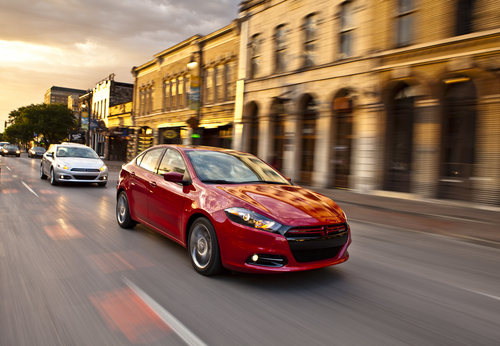
Happily, designers and engineers hit the bull’s-eye with this Dart.  With Euro DNA that goes beyond Fiat architecture and Alfa Romeo’s soul, the car also combines the very best of 1960s-70s all-America retro to make the new Dart a package of four-wheeled fun.  Driving it puts a smile on your face.

Funny thing is, I’m betting that most people don’t remember that the old Dart’s 1960-to-1976 run began as a wide, road-hogging, full-size model.  Fortunately, Dodge got wise and sized that car down to a zippy compact vehicle.

The old compact Dart is the essence of the 2013 Dart, only the new version is way better.

My tester was the Dodge Dart Rallye edition, which taught me that you have to do your homework on option packages and model offerings to single out the exact Dart of your dreams.  Think of the Rallye as a juiced-up edition of the Dart SXT.

Labels aside, my tester was thoroughly enjoyable.

The car has a decidedly sporty look from end to end, with sharp angles and clean lines that sort of beg you to get behind the wheel and stomp on the gas.  Power from the tested 1.4-liter, four-cylinder, turbocharged engine (160 horsepower) was enthusiastic, but not necessarily sports car robust.  You have to jump hard on the gas to get those turbo revs up and moving.

The Dart can move out when asked, but it won’t chase down a ’Vette.  It handles everything else quite well.  Performance fans will likely opt for the 2.4-liter, four-cylinder engine that will get you about 85 extra horses. 

In my test runs, the Dart Rallye’s accelerations created a fair amount of noise in the cockpit.  But handling was spot-on.  Braking was above average in this segment.

Safety features are off the charts, including driver-inflatable, knee-protecting airbags.  The center stack of controls threw me only a couple of curves as I mastered things within a day.  I particularly enjoyed the sporty black seats with centered stripes in Diesel Gray.  Very cool.

Fuel mileage numbers will please most at 27 miles per gallon in the city and 37 mpg on the highway.

As I said, given the varied features and models, it pays to check the Dart sticker closely.   For example, mine listed a base price of $17,995, but a long list of options pushed the bottom-line price to $24,460.  Quite the gap there, one you want to figure out BEFORE you’re signing documents in a dealer’s finance office.

One small gripe on the tester: a tardy, overly obvious traffic warning system.  Several times, five minutes into all-but-stopped commuter gridlock, a recorded voice jolted me with the announcement that there was “traffic ahead.”  Uh, thanks, Captain Obvious.

Here’s my advice: Go take a look at this car, even if you don’t plan to buy one.  You’ll like what you see.  Yes, the Dart had a truckload of pre-release hype.  But in this case, the car lives up to the publicity.